




Common Mistakes in Self-Managed Boiler Water Treatment: Hidden Risks and Unpredictable Losses
In an effort to reduce operational costs, many businesses choose to handle boiler water treatment on their own. However, a lack of technical expertise, inadequate monitoring equipment, and subjective judgment often lead to serious mistakes, resulting in severe consequences for the boiler system, operating costs, and overall plant safety.
.jpg)
With many years of experience in industrial water treatment, Reechem has witnessed — and resolved — countless cases of boiler damage caused by improper self-managed water treatment. Below are the most common mistakes companies tend to make:
I. Mistakes in the Boiler Feedwater Pretreatment Stage
Feedwater pretreatment is the foundation of an effective boiler water treatment program. Any errors at this stage will significantly impact subsequent processes.
Ignoring or Underestimating Water Quality Analysis
Mistake:
Many companies rely on visual assessment or simple, non-specialized testing.
Consequence:
Failure to understand key water characteristics (hardness, pH, TDS, silica, dissolved oxygen, heavy metals, ammonia, etc.) leads to improper selection of pretreatment systems (inadequate softening, no deaeration, etc.) or incorrect chemical selection/dosing. This results in waste and does not address the root problem — boilers may still scale and corrode despite being “treated.”
Improper Design or Operation of Water Softening Systems
Mistake:
Using low-quality resin, undersized softening tanks, or failing to regenerate the resin properly (using low-grade salt, insufficient salt, incorrect regeneration timing).
Consequence:
Feedwater retains high hardness, causing severe scaling in the boiler, reduced heat transfer efficiency, increased fuel consumption, and in severe cases overheating and tube deformation.
Lack of Deaeration or Ineffective Deaeration
Mistake:
Skipping the thermal deaeration step, operating the deaerator at insufficient temperature/unstable pressure, or failing to add oxygen scavengers.
Consequence:
Dissolved oxygen and carbon dioxide remain in the water — the main cause of pitting corrosion and grooving in boilers and steam/condensate piping. This leads to tube rupture, leakage, pressure loss, and potential explosion hazards.
II. Mistakes in Internal Boiler Water Treatment (Chemical Dosing)
Internal chemical treatment requires precision and continuous monitoring.
Using Inappropriate or Low-Quality Chemicals
Mistake:
Using chemicals with unclear origin, low-cost but poor quality products, or chemicals incompatible with boiler materials or operating conditions (pressure, temperature).
Consequences:
-
Ineffective treatment: scaling and corrosion persist
-
Additional problems: poor-quality chemicals may create more scale, cause corrosion, or lead to foaming
-
Safety risks: Some chemicals may corrode boiler metal or generate harmful byproducts
Incorrect Chemical Dosing (Overdosing or Underdosing)
Mistake:
Dosing based on estimation rather than water analysis, or using inaccurate manual dosing systems.
Consequences:
-
Underdosing: Insufficient protection against scale, corrosion, and microbial growth
-
Overdosing: Chemical waste, increased TDS, risk of carryover and contamination of steam lines, corrosion of valves/turbines. Some chemicals, when overdosed, can corrode metal (e.g., excessively high pH, overuse of chelating agents).
Failure to Regularly Monitor Boiler Water Parameters
Mistake:
Adding chemicals without monitoring key indicators (pH, alkalinity, TDS, phosphate residual, sulfite residual, etc.).
Consequence:
There is no way to know whether the treatment program is effective, which often leads to undetected scaling or corrosion until a major failure occurs.
Neglecting Condensate Return Line Treatment
Mistake:
Ignoring pH and corrosion control in the condensate return system.
Consequence:
CO₂ dissolves in condensate to form carbonic acid, causing corrosion in condensate piping. This corrosion creates leaks and returns iron oxide deposits back to the boiler, forming sludge and new scale.
III. Severe Consequences of Incorrect Self-Managed Boiler Water Treatment
These mistakes can cause serious damage that businesses must bear:
-
Sharp increase in fuel costs:
A 1mm scale layer can increase fuel consumption by 10–30%, translating into hundreds of millions of VND annually. -
High maintenance and repair costs:
Tube failures, leaks, valve and pump damage, and component replacement. -
Production downtime:
Boiler failures disrupt operations, causing revenue loss and damaging reputation. -
Reduced boiler lifespan:
Instead of 15–20 years, a boiler may require major overhaul or replacement after only a few years. -
Safety hazards and explosion risks:
High boiler pressure combined with overheating and corrosion increases the risk of explosions. -
Increased wastewater treatment costs:
Improper or excessive chemical use leads to higher pollutant levels in blowdown water.
IV. Safe and Effective Solutions from Reechem
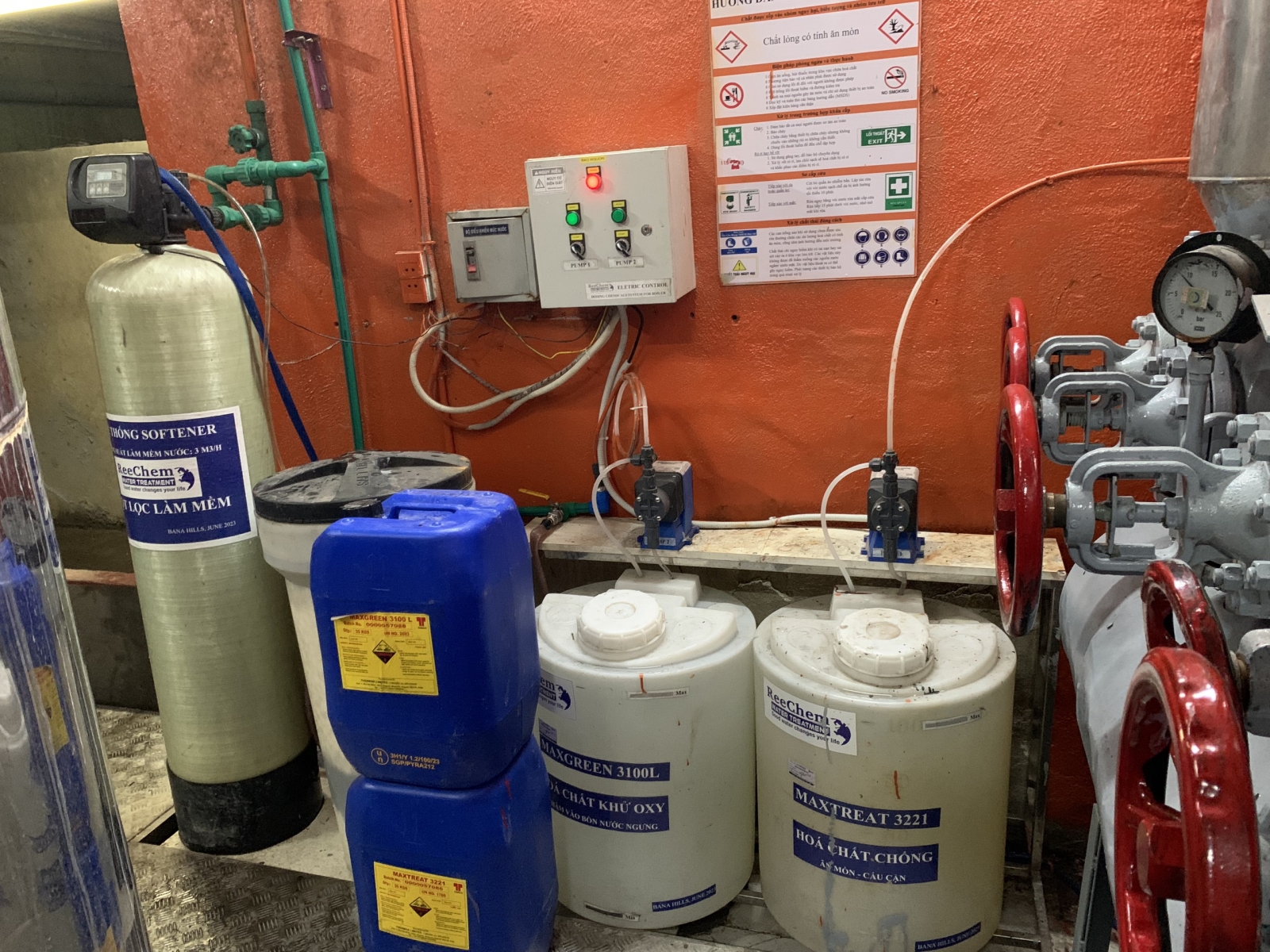
To avoid these mistakes and risks, businesses should seek support from boiler water treatment experts. Reechem offers comprehensive and professional solutions:
-
FREE survey, water analysis, and system assessment:
We identify the exact issues in your water source and boiler. -
Customized, optimized water treatment programs:
From pretreatment to internal chemicals, with precise dosing for every boiler type. -
High-quality chemicals and automatic dosing systems:
Ensuring stability and long-term effectiveness. -
Periodic monitoring and quality control:
Reechem engineers regularly check key parameters and make necessary adjustments. -
Continuous technical support and consultation:
Ensuring your boiler system operates smoothly, efficiently, and safely.
Do not let initial cost-saving efforts turn into major long-term losses!
Investing in professional boiler water treatment from Reechem means investing in operational performance, equipment longevity, and sustainable safety.
If you are facing challenges with boiler water treatment, contact Reechem now for FREE consultation and expert solutions!
REECHEM CO., LTD
Address: 5th Floor, Lighthouse Building, 1254 Xô Viết Nghệ Tĩnh St., Hòa Cường Nam Ward, Hải Châu District, Da Nang City
Phone: 0236 391 88 68 / Hotline (Zalo): 0789 086 626
Email: info@reechem.com.vn
Website: reechem.com.vn